About this episode
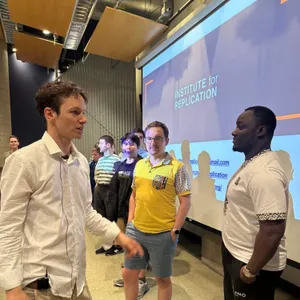
The world of science has been stuck in an existential crisis over whether we actually know the things we thought we knew. Re-running an old study today doesn't always yield the same result. Same with re-enacting old experiments. Collectively, this is known as the “replication crisis.” <br/><br/>Economist Abel Brodeur has come up with one way to help fix this crisis: he’s invented an internationally crowdsourced surveillance system, designed to keep social scientists honest. He calls it the “Replication Games.” <br/><br/>Further Listening:<br/><br/><ul class="rte2-style-ul" style="margin-top:0;margin-bottom:0;padding-inline-start:48px;"><li><a href="https://www.npr.org/2023/07/27/1190568472/dan-ariely-francesca-gino-harvard-dishonesty-fabricated-data"target="_blank" >Fabricated data in research about honesty. You can't make this stuff up. Or, can you? </a></li><li><a href="https://www.npr.org/sections/money/2016/01/15/463237871/episode-677-the-experiment-experiment"target="_blank" >The Experiment Experiment </a></li><li><a href="https://www.npr.org/sections/money/2013/04/19/177999020/episode-357-how-much-should-we-trust-economics"target="_blank" >How Much Should We Trust Economics?</a></li></ul><br><em>This episode was hosted by Mary Childs and Alexi Horowitz-Ghazi. It was produced by James Sneed and Emma Peaslee, with help from Willa Rubin. It was edited by Jess Jiang, fact-checked by Sam Yellowhorse Kesler, and engineered by Ko Takasugi-Czernowin. Alex Goldmark is Planet Money’s executive producer. </em><br/><br/><em>Find more Planet Money: </em><a href="https://n.pr/3h92GwS"target="_blank" ><em>Facebook</em></a><em> / </em><a href="https://n.pr/3FqLuws"target="_blank" ><em>Instagram</em></a><em> / </em><a href="https://n.pr/3sGZdrq"target="_blank" ><em>TikTok</em></a><em> / Our weekly </em><a href="https://n.pr/3zrFvUB"target="_blank" ><em>Newsletter</em></a><em>.</em><br/><br/><em>Listen free at these links: </em><a href="http://n.pr/PM-digital"target="_blank" ><em>Apple Podcasts</em></a><em>, </em><a href="https://n.pr/3gTkQlR"target="_blank" ><em>Spotify</em></a><em>, </em><a href="https://n.pr/3Bkb17W"target="_blank" ><em>the NPR app</em></a><em> or anywhere you get podcasts.</em><br/><br/><em>Help support Planet Money and hear our bonus episodes by subscribing to Planet Money+ </em><a href="http://n.pr/PM-digital"target="_blank" ><em>in Apple Podcasts</em></a><em> or at </em><a href="https://n.pr/3HlREPz"target="_blank" ><em>plus.npr.org/planetmoney</em></a><em>.</em><br/><br/>See <a href="https://pcm.adswizz.com">pcm.adswizz.com</a> for information about our collection and use of personal data for sponsorship and to manage your podcast sponsorship preferences.<br/><br/><a href="https://www.npr.org/about-npr/179878450/privacy-policy">NPR Privacy Policy</a>