About this episode
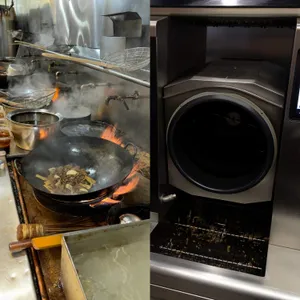
Robby the chef has lots of endearing qualities. He can make over 5000 dishes, he’s a consistent cook, and he’s never late for work. But he’s not a human. It is a 750 lb. stainless steel robot. With a rotating wok at its center. It’s a wok-bot. <br/><br/>Automation has changed many industries. But automation only started entering restaurant kitchens in the past couple decades. Which raises the question – what will robots mean for the restaurant industry? How will automation change jobs and how will it change the very food we eat?<br/><br/>Today on the show, we talk with a Nobel prize-winning economist, <a href="https://economics.mit.edu/people/faculty/daron-acemoglu"target="_blank" >Daron Acemoglu</a>, about when automation is complementing or displacing workers. And we decide to put this wok-bot to the test. We pit a human chef against Robby the wok-bot in a head-to-metalhead smackdown. <br/><br/>Further Listening/Reading:<br><ul class="rte2-style-ul"><li><a href="https://www.npr.org/2023/05/16/1176516094/artificial-intelligence-david-autor-chatgpt-labor"target="_blank" >How AI could help rebuild the middle class</a> </li><li><a href="https://www.npr.org/sections/money/2015/07/29/427467598/episode-642-the-big-red-button"target="_blank" >The Big Red Button</a> </li><li>Check out our AI series: <a href="https://www.npr.org/series/1178395718/planet-money-makes-an-episode-using-ai"target="_blank" >Planet Money makes an episode using AI</a></li><li><a href="https://www.npr.org/sections/money/2021/01/19/957240511/why-nations-fail-america-edition"target="_blank" >Why Nations Fail, America Edition</a> (newsletter)</li><li><a href="https://www.npr.org/sections/money/2021/06/22/1008354992/a-new-way-to-understand-automation"target="_blank" >A New Way To Understand Automation</a> (newsletter)</li></ul><a href="https://tix.to/pm-book-tour"target="_blank" ><em>Get your book tour tickets here.</em></a><em> / </em><a href="https://www.planetmoneybook.com/"target="_blank" ><em>Pre-order the Planet Money book and get a free gift</em></a><em>.</em><br/><br/><a href="https://n.pr/3HlREPz"target="_blank" ><em>Subscribe to Planet Money+</em></a><br/><br/><em>Listen free: </em><a href="http://n.pr/PM-digital"target="_blank" ><em>Apple Podcasts</em></a><em>, </em><a href="https://n.pr/3gTkQlR"target="_blank" ><em>Spotify</em></a><em>, </em><a href="https://n.pr/3Bkb17W"target="_blank" ><em>the NPR app</em></a><em> or anywhere you get podcasts.</em><br/><br/><a href="https://n.pr/3h92GwS"target="_blank" ><em>Facebook</em></a><em> / </em><a href="https://n.pr/3FqLuws"target="_blank" ><em>Instagram</em></a><em> / </em><a href="https://n.pr/3sGZdrq"target="_blank" ><em>TikTok</em></a><em> / Our weekly </em><a href="https://n.pr/3zrFvUB"target="_blank" ><em>Newsletter</em></a><em>.</em><br/><br/><em>This episode was hosted by Erika Beras and Justin Kramon. It was produced by Sam Yellowhorse Kesler. It was edited by Jess Jiang. It was fact-checked by Sierra Juarez and engineered by Robert Rodriguez with help from Cena Loffredo. Interpretation help from Huo Jingnan. Alex Goldmark is </em>Planet Money<em>’s executive producer.</em><br/><br/>See <a href="https://pcm.adswizz.com">pcm.adswizz.com</a> for information about our collection and use of personal data for sponsorship and to manage your podcast sponsorship preferences.<br/><br/><a href="https://www.npr.org/about-npr/179878450/privacy-policy">NPR Privacy Policy</a>